Autoimmunity
Autoimmunity
•
autoimmune disease - is immune
responses of an organism against its own healthy cells, tissues and other body
normal constituents
•
Resulting disease - Autoimmunity
means presence of antibodies or T cells that react
with self-protein and is present in all individuals, even in normal
health state.
•
It causes autoimmune diseases if self-reactivity
can lead to tissue damage
•
Autoimmune diseases is a group of
disorders in which tissue injury is caused by Ab (by auto-antibodies) or CMI
(by auto-reactive T cells) to self-antigens.•
•
An autoimmune disorder may result
in:–
v The
destruction of one or more types of body tissue–
v Abnormal
growth of an organ
v Changes
in organ function
Autoimmunity
causes:
1) is caused by abnormal and excessive
activity of one or both of the immune system effector cells. in case of
excessive activity of B-cells, we have excess antibodies and excess activity of
T – cells, leads to infiltration of tissues by T-lymphocytes and
macrophages
2.
Failure of immune system to discriminate
between self and non-self antigens
3. Exposure to hidden antigen
4. Immunization to cross-reacting antigens that share
immunogenic determinants with autoantigens
5. Intense stimulation of lymphocytes due to use of
adjuvants for immunization-leads to overproliferation of lymhpocytes leading to
attack of self antigens
6.
The immune system is under regulation and the regulation involves receiving
signals from regulatory system. The regulatory signals may become abundant due
to interference of the control system. This results to abnormal response that
leads to autoimmunity. The net effect of this abnormal activity leads to injury
to self tissues.
•
So autoimmunity in effect is a
reflection of loss of immunological tolerance to self tissues antigens through
a number of processes
•
Auto
–immune Diseases
1) Haemolytic
autoimmune diseases
2) Localised
autoimmune diseases
3) Systemic
autoimmune diseases
I.
Haemolytic autoimmune diseases•
•
Clinical disorder due to destructions
of RBC by autoantibodies
•
Auto Ab attack RBCs, Platelets or
Leucocytes .•
E.g.
•
Haemolytic anaemia,
•
Leucopenia,
•
Thrombocytopenia
2.
Localized autoimmune disease
A
particular organ is affected due to auto Abs.-
} Eg:–
1) Thyroiditis
(attacks the thyroid)–
2) Myasthenia
gravis (attacks nerve-muscle junction)–
3) Juvenile
diabetes or Type I DM (attacks insulin-producing cells)
} Hashimoto’s
thyroiditis•
} Hypothyroidism & destruction of thyroid
cells
} Characterised
by Goitre, enlarged thyroid gland
} Characterized
by Type IV hypersensitive reactions
} It
is a T-cell associated auto immune disease .
} Myasthenia
Gravis• Caused by auto antibody against muscle antigen & acetylcholine
receptor antigen.•
Type
I diabetes• β cells
produce little or no insulin. Heritable, Symptoms are like being very thirsty,
hungry, tired or fatigued, urinating more often.
3.
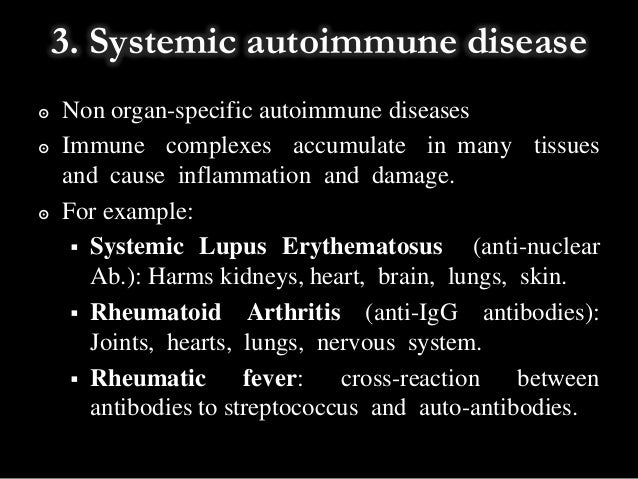
Systemic autoimmune disease
v
Non organ-specific
autoimmune diseases
v
Immune complexes accumulate in many
tissues and cause inflammation and damage.
E.g.:
Harms kidneys, heart, brain, lungs, skin
I .Systemic Lupus Erythematosus (SLE): Skin
disease due to the production of anti-nuclear factor (ANF) . In these patients, SLE cell (a mature
neutrophil) appears in blood & bone marrow–
Function – Phagocytosis in the presence of ANF.
} Disease of the joints
} Caused by the
auto Antibody of IgM type, called rheumatoid factors.
} The synovial fluid of these patients contain
increased no. of T-cells & macrophages.
} Marked by
inflammatory changes in the synovial membrane.• In later stage, deformity
develops.
HLA, Genetics and Disease
1. This
group of genes resides on chromosome 6.
•
Certain individuals are genetically
susceptible to developing autoimmune diseases.
•
This susceptibility is associated with multiple
genes plus other risk factors.
•
Genetically predisposed individuals
do not always develop autoimmune diseases.
•
Three main sets of genes are
suspected in many autoimmune diseases. These genes are related to:
v
Immunoglobulins
v
T-cell receptors
v
The major histocompatibility
complexes (MHC).
Genetic factors
•
The
first two (Ig &TCR), which are involved in the recognition of antigens, are
inherently variable and susceptible
to recombination.
•
These variations enable the immune system to respond to a
very wide variety of invaders, but may also give
rise to lymphocytes capable of self-reactivity.
•
HLA
DR2 is strongly positively correlated with systemic lupus erythematosus and multiple sclerosis, and negatively correlated with DM Type 1.
• HLA
DR3 is correlated strongly with myasthenia gravis, SLE, and DM
Type 1.
•
HLA DR4 is correlated with the
genesis of rheumatoid arthritis, Type 1 diabetes mellitus,
•
Fewer correlations exist with MHC
class I molecules.
•
The most notable and consistent is
the association between HLA B27 and ankylosing
spondylitis and reactive arthritis.
•
Recently, PTPN22 locus
is one of the strongest risk factors outside of the MHC that associates with
autoimmune diseases.
•
PTPN22-(Protein
tyrosine phosphatase, non-receptor type 22)
•
PTPN22 encodes
lymphoid protein tyrosine phosphatase (Lyp) which is expressed exclusively
in immune cells.
•
PTPN22 plays
roles in lymphocyte dev’t and activation, establishment of tolerance, and
innate immune cell–mediated host defense and immunoregulation
•
•
A single base change in the coding
region of this gene resulting in an arginine to tryptophan AA substitution (within
a polyproline binding motif) associates with type 1
diabetes, rheumatoid arthritis, systemic lupus
erythematosis, Hashimotos thyroiditis, Graves
disease, Myasthenia Gravis
•
Treatment
•
immunomodulation
•
Some autoimmune diseases are treated
with medications that Target specific symptoms
•
Haemolytic anaemia:
Treated with Vit B12, iron
•
SLE : Treated with NSAIDS such as
ibuprofen or naproxen, antimalarial drugs, and corticosteroids
•
In more aggressive cases,
immunosuppressive drugs maybe used.
Immunosuppressive
drugs
Drugs that inhibit or prevent activity of the
immune system
1.
Immunosuppressive drugs can be
classified into four groups:
v Glucocorticoids (suppress allergic,
inflammatory and autoimmune disorders) .
v Cytostatics (inhibit cell division) .
v Antibodies (prevent the
acute rejection and targeted treatment of autoimmune disorders) .
v Drugs
acting on immunophilins (Cyclosporin A,Tacrolimus)
Reference
v Hussain
Y, Khan H. Immunosuppressive Drugs. Encyclopedia of Infection and Immunity.
2022:726–40. doi: 10.1016/B978-0-12-818731-9.00068-9. Epub 2022 Apr 8. PMCID:
PMC8987166.

Comments
Post a Comment